Today we will talk about cat food. To find out how much a cat should eat, we will look at the factors that influence its daily energy requirement (RED), its recommended feeding frequency and its feeding method.
First, we will discuss these factors:
Factors influencing daily energy requirement
To know how much food your cat needs, we first need to know its daily energy requirement (DER). There are several factors that determine the amount of food your cat needs to eat daily:
Body Weight (Metabolic Weight)
Your cat’s size will be the most key factor in determining the amount of food it will need to eat daily. Logically, small cats require less food than larger breeds. However, this relationship is not linear. Small cats have a larger body surface are, relative to their body weight, than larger cats. For this reason, their heat loss is also proportionally greater and, therefore, their daily energy requirement is also higher.
Age and Life Stage
Kittens, adult cats, and senior cats have different nutritional requirements. Kittens need more energy for growth and development, while older cats may need dietary adjustments to prevent weight gain due to a decrease in their activity level and a slower metabolism caused by loss of muscle mass.
Breed
Some breeds have faster metabolisms or are predisposed to certain conditions that affect their calorie needs. For example, the insulation characteristics of their skin and coat (i.e.: a Sphynx cat is not the same as a Persian cat) and temperament (whether they are high-strung or calm) are factors that will influence their daily energy requirements.
Sexual Status
Spayed or neutered cats are generally less active and tend to have a slower metabolism due to lower hormone levels and decreased muscle mass, which can increase the risk of becoming overweight if their diet is not adjusted.
Body Condition
A cat’s body condition influences the amount of food it needs. An overweight cat should be fed a calorie-controlled diet, while a thin cat may need a higher calorie intake.
Ambient Temperature
The climate influences energy requirements. If the animal is in a thermoneutral zone (neither hot nor cold), it won’t need extra energy, but whether it is hot or cold, it will need energy to try to regulate its body temperature.
Activity Level
An active cat burns more calories and requires a higher food intake compared to a sedentary cat.
Housing Type
Indoor cats tend to be less active than those with outdoor access, which influences their caloric needs. They also tend to expend fewer calories on thermoregulation.
Physiological Condition
Growing kittens and pregnant or lactating females have higher energy requirements to support growth and milk production.
Health Status
Medical conditions such as diabetes, hyperthyroidism, or kidney problems can affect daily energy requirements and can also increase or decrease appetite.
Recommended Feeding Frequency in Cat Food
The number of times a cat should eat per day depends on its age, health, and preferences. Kittens require several meals per day (four to six times a day at weaning), while adult cats may eat only two or three times a day.
However, to avoid lower urinary tract problems (especially urolithiasis caused by struvite stones), it is recommended to feed them as often as possible, as this helps maintain a more stable urine pH, as shown in Figure 1. In fact, if given free access to food, cats typically eat between 12 and 20 times a day, evenly distributed throughout the 24-hours light-dark cycle.
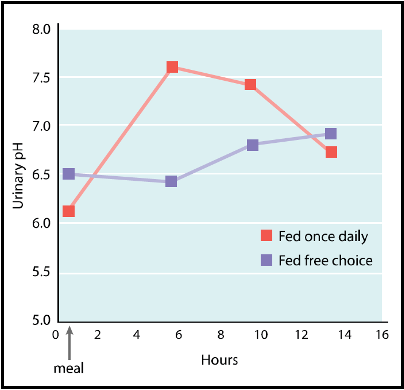
Figure 1: Mean urinary pH of cats fed a commercial food either free choice (i.e., ad libitum) or once daily. Note how once daily feeding results in a significant increase in urinary pH. (Adapted from Taton DF et al., 1984).
Feeding Method for Cat Food
Related to the previous point, the way we administer food is very important. There are different feeding methods:
Ad Libitum
This method allows the cat continuous access to food in unlimited quantities.
It is an easy and convenient method, as we do not have to weight or measure the food. This method will be suitable for thin animals or those with high energy demands (e.g. lactating females). It is also a method that allows subordinate animals to access food when several animals live in the same house.
The problem is that we have to rely on energy self-regulation (and it doesn’t always work), which can lead to overweight. It also won’t allow us to identify any problems with decreased food consumption that could indicate the onset of a disease. And it can only be used with dry food, as wet food would spoil.
Cat Food Rationed by Time
Food is offered only for a limited time, which helps regulate intake and prevent weight gain, although this method is rarely used.
It has the advantage of being easy and convenient (because we don’t have to weight or measure the food) and can be used with both dry and wet food.
The problem is that it can increase gluttony and aerophagia (air swallowing). We must also rely on energy self-regulation, as some animals have a high intake capacity in a short period of time.
Cat Food Rationed by Quantity
The exact amount of food a cat should consume is measured according to its energy requirements, and it can eat whenever and however it prefers throughout the day or spread out over several feedings by the owner. This is, without a doubt, the most widely used method.
The advantages are that it allows us to carefully monitor intake, allowing us to detect the onset of any problems early. It’s also the best option for preventing overweight, as we monitor calorie intake.
The drawback is that it requires a little more time and effort, as we must weight or measure the food according to the manufacturer’s recommendations, either through online calculators or the rationing tables printed on the packaging, based on your cat’s weight, age, and activity level.
However, each cat is unique, and its requirements can differ significantly (±50% from the calculated value). Therefore, the manufacturer’s recommended daily ration should only be used as a starting point and should be adjusted every 2-4 weeks according to your cat’s response.