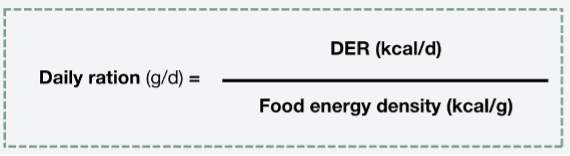
To know how much food our dog needs, we need to know, first, its daily energy requirement (DER) and, second, the energy density of the ration we want to feed it.
Factors That Influence Daily Energy Requirement
In order to know how much dog food to give your dog, it is important to know the factors that influence the daily energy requirement:
Dog Weigh and Size (Metabolic Weight)
The dog’s size is the most determining factor that will determine the amount of food for dogs that it will need to eat daily. As it is logical to think, small dogs require less amount of food compared to large breeds. However, this relationship is not linear. Small dogs have a larger body surface area, in proportion to their body weight, than large dogs. For this reason, their heat loss is also proportionally greater, and therefore, their daily energy requirement is also higher. Colloquially speaking, “a kilo of Chihuahua should eat more than a kilo of Great Dane”.
Age and Life Stage
Energy requirements decrease with age. Growing puppies need much more energy than adult dogs, and these, in turn, need more than senior dogs.
Breed
Some breeds have faster metabolisms or are predisposed to certain conditions that affect their calorie requirements. For example, the insulation characteristics of their skin and coat, and temperament (whether they are high-strung or calm) are factors that will influence their daily energy requirements.
Sexual Status
Sterilized dogs tend to be less active and have a slower metabolism due to their lower hormone levels and decreased muscle mass, which may require dietary adjustments to prevent weight gain.
Body Condition
A dog’s body condition is key to determine its daily energy requirement. An overweight dog needs fewer calories, while a thin dog may require an increase in its caloric intake.
Ambient Temperature
The climate influences energy requirements. If the animals is in a thermoneutral zone (neither hot nor cold), it will not need extra energy, but whether it is hot or cold, it will need energy to try to regulate its body temperature. If it is hot, it will pant to dissipate heat (in this case, it will also need extra water intake). On the other hand, if it is cold, it will begin to shiver, so that muscle contractions generate heat (this is called thermogenesis).
Activity Level
An active dog that exercises regularly will need more calories than a sedentary dog. This increased energy requirement will be determined by the duration of the activity and the type of activity.
Housing Type
Dogs that live outdoors require more energy than those that live indoors, as they expend more calories on thermoregulation and daily activity.
Physiological Condition
Growing puppies and pregnant or lactating females have higher energy requirements to support development and milk production.

Health Status
Medical conditions such as diabetes, kidney problems, or joint disease can affect daily energy requirements.
Factors Affecting the Energy Density of a Pet Food
Animals do not eat by volume; rather, they eat the amount of food needed to meet their daily energy requirement. In other words, a dog will need to eat less of a food with a higher energy density than another with a lower energy intake. Therefore, the energy density of the food will determine the amount or volume of food to be fed. The factors that most influence the energy density of a pet food are the following:
Water Content
The choice among dry, wet, or mixed food significantly influences the daily amount of food that should be given to the dog. Wet food typically has fewer calories per gram due to its higher water content (>60%), so a larger amount is required compared to dry food.
Fat and Fiber Content
These are the two nutrients that can most influence the energy density of a food. Therefore, diets with very different contents of these two nutrients may recommend very different daily rations for the same animal. The denser a diet is (i.e., higher in fat and lower in fiber), the less volume or quantity we will need to feed to satisfy the same number of daily calories.
How to Calculate the Proper Ration for Your Dog
We are going to explain some of the different methods that exist for calculating the dog food ration, as you will see, not all of them are exact and they can vary from dog to dog.
Prediction Equations
The equations proposed by institutions such as the FEDIAF, the NRC, and the AAFCO allow estimating an animal’s daily energy requirement based on the factors detailed above. These are complex equations and are typically used by specialized nutritionists. However, each dog is unique, and its needs can different significantly (± 50% from the calculated value), so they should only be used as a starting point.
Body Weight Percentage Method
This method involves feeding the dog a percentage of its body weight, but it is a very inaccurate method, as it does not take into account the factors described above or the energy density of the food, which can lead to significant errors in the amount fed. While adult dogs may require between 2 and 3% of their weight in daily food, puppies can require up to 10%.
Online Calculators
The digital tools that manufacturers make available to their customers can help calculate the daily ration based on the dog’s weigh, age, and activity level, although it is always recommended to adjust it based on the dog’s response.
Reference Tables
Just like online calculators, manufacturers are required to indicate on food packaging the recommended daily ration based on the dog’s weight, age, and activity level, as a guideline amount based on the energy density of that specific food.